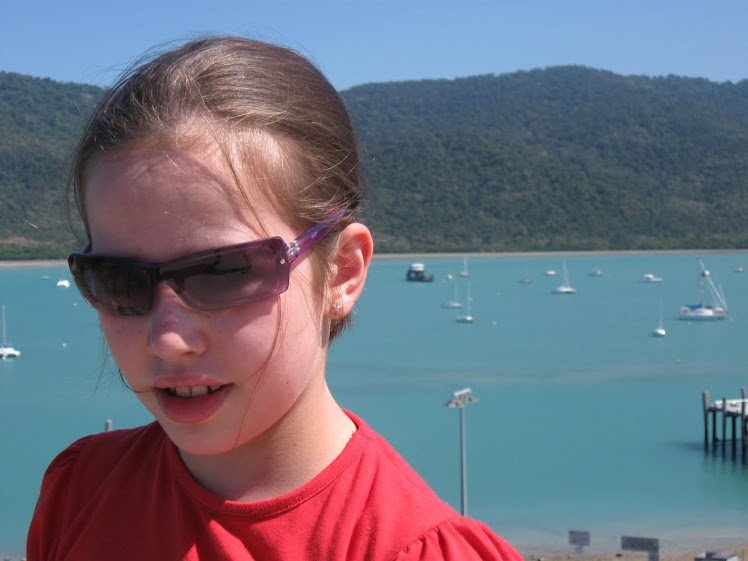
Freya in the Whitsunday's last year

Freya in the Whitsunday's last year

Tuesday, December 7, 2010

settling in

After a lovely holiday in Noosa, we are all settling into our post-hospital routine.  This routine revolves around a weekly timetable of daily out-patient appointments at the RCH which can involve only one or two sessions or a full day.  Freya has also been very keen to return to school and participate in as many activities as possible before the end of the school year next Friday.  The rigorous RCH timetable doesn't allow for much school time, but she has managed to spend a couple of hours at school several times over the last week and a half.  In addition to the excitement of seeing all her school friends and teachers again, it has given her mood and confidence a huge kick-start to be doing 'normal' things again.  Thank you so much to Ms Sear and  5/6S for giving her such a heroes welcome.

Freya is also receiving Occupational Therapy at home twice as week as part of a new initiative of the RCH "Hospital in the Home" Program.  The home visits are about encouraging her to use her left arm and hand as "helpers" as much as possible in a practical, everyday way.  Because her left arm and hand ares so weak, and using either takes such effort, is is very easy for children who have had hemispherectomy surgery to simply ignore their weak arm and hand and rely entirely on the stronger ones.  Without constantly thinking about, and  trying to use her weak arm and hand Freya's brain will not make the neuro-connections needed to make them functional, so it can become a cycle of weakness and neglect, something that we would really like to avoid.

This week at the hospital is a busy one:  On Thursday, Freya will receive her first botox injections (young, I know).  The botox is intended to reduce the stiffness in her left calf muscles to give her a more natural gait and also allow her left hand to relax more readily.  I'm sure I won't be the first mother that has argued for a bit of botox to administered in my direction given the all the extra wrinkles she has caused me over the last months (years).  Freya will also be having her first EEG and MRI since the surgery.  Although she appears to be completely seizure-free, the EEG should confirm that there are no sub-clinical seizures occuring in her brain (those that have no obvious or outward presentation).  All fingers crossed.

Here's Freya enjoying the Noosa beach from the safety of her beach towel.  Despite the balmy 27 degree weather she declared both the resort pools (heated) and sea too cold for swimming.  3 months in the airconditioned comfort of the RCH has made her very soft!


Friday, November 19, 2010

home

Today Freya was discharged from the RCH, just short of 100 days since admission.  In this period and the weeks before she was admitted, she has experienced status epilepticus (a life-threatening state of near continuous seizure activity), the most radical of all brain surgery on 31 August, and then following this surgery total paralysis on the  left side of her body.  In these same 100 days she has also learnt to sit, stand and walk again. It has been a busy few months.

Physically, with the exception of her left arm and hand, she is stronger and fitter than she has been for a long time.  She can now walk without experiencing leg seizures and today she was assessed as having 80% of the walking speed and endurance of the average 11 year old girl.  Over the last few weeks, we have been regulars at the hospital orthodics department to have her leg orthosis re-adjusted as her left leg muscles have continued to bulk up.

Cognitively, things are improving at a slower pace. By the end of each day (and often for periods during the day) the demands of her physical and cognitive rehabilitation leave her exhausted to the point where even a  simple conversation is beyond her capacity.  During these periods of cognitive fatigue, she cannot maintain eye contact, follow the thread of a conversation or even respond to questions.  As her brain recovers from the surgery and the left hemisphere continues to pick-up the functions of her now defunct right hemisphere, this cognitive fatigue should reduce and Freya will become more like her happy, bright former self.

In light of what her brain has been through over the past five years, we need to be patient and accept that full recovery is going to be a slow process.  We are really hoping that now she is home and out of the hospital environment and engaging in more normal interactions with friends, family and neighbours, her cognitive recovery will be given a healthy boost.

Wednesday, November 10, 2010

a discharge date

Following our family meeting with Freya's doctors and therapists on Tuesday a discharge date has been agreed;  Freya will be leaving the Royal Children's Hospital next Friday, the 19th of November - 3 months and 1 week since admission and 2 months and 3 weeks since her surgery.  After such a long stay, the RCH has begun to feel like a second home, and while we're all keen to come home, I know Freya will miss the many nurses, doctors and therapists who have provided her with such support, kindness and encouragement over the last few months.  The hospital umbilical cord will not be severed abruptly though, the discharge plan that we will be given before we leave will include out-patient therapy appointments three times a week for the next couple of months.

In addition to the out-patient therapy we will also be given a rigorous schedule of physio and OT exercises to complete daily at home. As the doctors have explained to us, Freya's brain is currently going through a spurt of activity that is resulting in movement in her left arm, with almost daily improvements over the last week.  It is important that we capitalise on the new connections her left hemisphere is making before this spurt of activity slows down or stops.  The photo is Freya doing one of her physio exercises - putting weight on her left arm (and being kept company by Ella). 

To celebrate Freya's recovery from her surgery and triumph over the devastating epilepsy and encephalitis that has plagued most of her childhood, we are off to Noosa the day after hospital discharge.  A new 5 star resort has opened a couple of months ago, with a lagoon style pool - just the thing for continuing her hydrotherapy program.  The doctors agree it's a great idea too.  Ella doesn't seem to be too devastated by missing out on a week of school so close to the end of the year either.

Sunday, October 31, 2010

two triumphs

This weekend has been a good one for Freya, with two terrific milestones being reached.  The first is that it is now 2 months since Freya's hemispherectomy surgery, and 2 months since she has had any form of seizure.  It is hard to imagine that such a short time ago, her brain was so on fire from constant seizure activity that she could hardly walk 50 metres without experiencing a seizure in her leg.  Even in her sleep, she was continually woken by many seizures a night.  Given her surgeon's complete confidence in the success of the surgery, her medication is also being further reduced. Another of Freya's anti-epileptic medications is now being weaned (3 down, and 2 to go) and the plan of her neurologist is that she be medication-free by Christmas.  After years of increasing medications at increasing doses, it's great to be on the reverse cycle.

The second of the weekend events, is that Freya has started to gain a bit of movement in her left arm.  When she concentrates, she can now flex her arm at the elbow. This is exciting as it indicates her brain's left hemisphere is making the necessary new wiring to "talk" to her left arm.  Having the ability to control her arm at the elbow will also have big implications for it's functional use.  It is hoped that eventually she will be able to put her left arm on a table or desk, without having to lift it with the other arm.  The left arm can also become much more of a 'helper' arm if is not just dangling uselessly by her side.  Freya has been worried for sometime about the lack of progress in her arm, so it is really encouraging for her to experience this small amount of movement.

Sunday, October 24, 2010

home on the horizon

With the possibility that Freya will be discharged from the RCH in 3-4 weeks, all of her rehabilitation sessions will be directed to getting her ready to come home and function as independently as possible on her return.  We will be having some of her O.T. sessions here at home, so Freya can practice doing things such as making her own breakfast and making her bed by herself in own environment.  (I've been too embarrassed to tell Jane, the O.T. that these were things Freya actually didn't do by herself before the surgery!).

Very important will also be teaching Freya to safely navigate our winding staircase to the upstairs bedrooms.  She is beginning to re-learn the skill of walking up and down stairs in physiotherapy, but it will still be a couple of months before her left ankle is strong and she will be declared safe and steady enough to tackle the staircase at home.

Over the next few weeks, Freya will also be having a range of cognitive tests to establish if there are any particular areas that she will need additional assistance with next year at school.  We are expecting her to be challenged by maths concepts and visual spatial tasks, as these are functions that usually reside in the right brain, and often their transfer to the left brain can take some time.  Last Friday, Miss Sear, Margot Sheridan and the acting principal of Fairfield Primary School,  Anne Morton came to the hospital to meet with Anthony, myselfI and the Rehab. Unit's education co-ordinator to discuss Freya's transition back to school.  Thank you so much Rachael, Anne and Margot for your wonderful concern, support and enthusiasm for Freya's return to school - we are so grateful for all your efforts and ideas.

Freya has been missing school very much, and we really hope she will be well enough to join in some of the fun end of year activities, before returning for the serious stuff in 2011.

Monday, October 18, 2010

up and away

In the 6 weeks since the surgery that left her with a complete left-sided hemiparesis (paralysis), Freya has re-learnt the skill of walking independently.  Assisted by her ankle and foot orthosis (AFO) Freya's gait is now actually better than it was immediately before her surgery.  Proof of this came when we viewed video footage of Freya's walking made by the physiotherapists the day before her operation.  Anthony and I hadn't  realised just how badly Freya's limp had become in the last six months until we saw this video.

Everyday Freya wants to walk further and further, and today she achieved over a kilometre. The physios are actually telling Freya not to walk as much as she wants to, because physical fatigue is still a big issue and it important that she maintain a quality gait, which does tend to deteriorate as she becomes tired.  Being able to walk again has had a huge positive impact on Freya's mood and confidence, and has inspired a  determination in physio and OT that I had doubted she would have.  We are very proud of her.

Here is a photo of her taken today, in full stride.

Saturday, October 16, 2010

new hope for Rasmussen's Encephalitis (RE)

Tomorrow my sister Deirdre arrives home the US after attending the first major conference on Rasmussen's Encephalitis.  Deirdre and I have both been involved (Deirdre much more than me) in researching and writing background papers for the conference.  There has been very little research into the causes and medical cures for RE due (1) the rarity of the disease, and (2) a surgical cure is available through hemispherectomy surgery.  The problem is of course, that this surgical cure comes at a significant cost to the child, and it is a very blunt and non-targeted way of dealing with an immunological disease.  Also, this surgical cure has not changed much in the last 50 years.  We think 21st century medicine should be capable of providing a more sophisticated and less brutal approach to dealing with chronic inflammation in the brain than simply removing or disconnecting the effected half.

At the conference, over 50 of the world's key players in RE and top immunologists, biochemists and geneticists came together to discuss the future course of research that may yield a cure for RE.  They all agreed that RE is 'ripe' for research and a key group of doctors will meet again in February to agree a research agenda.  Top of the list will be setting up a process for researchers to gain access to brain tissue from RE children.  We are very glad that we insisted the Royal Children's Hospital store some of Freya's brain tissue for future research purposes.  We will happily donate it to a research brain tissue bank.

Some of the specialists at the conference also felt that specific treatments available for MS sufferers may potentially benefit RE children.  Deirdre tells me there was a great deal of excitement and enthusiasm at the conference for the type of research that could be conducted, and some believe that current treatments for other neuro-inflammatory disorders might be applicable for RE children.

Fingers crossed that this conference represents a turning point that will jump start research into understanding and curing RE - hopefully saving future children from this debilitating disease.